Can the Rocky Mountains Go Car-Free?
Preserving winter experiences for future generations is important to me, and is one of the reasons I care about urban, energy, and transport policy.
In much of the world though, a passion for winter sports contributes to winter's gradual decline. Winter tourism, like all tourism, is fairly hard on the environment - there's a lot of flying, driving, and consumption involved. In North America, going skiing generally looks something like this. Big cars, long drives, and no alternative.

It doesn't have to be so tough on the environment though. Nikolai Schirmer, a back country-skier based in Norway, shows that even a pro can practice the sport sustainably. He mostly skies locally, avoids heli-skiing, and travels across Europe by EV or train. Closer to home, I was able to ski this past winter without driving thanks to Switzerland's extensive mountain rail network.
While I recognise that the venn diagram of people who ski and think about their transportation carbon footprint is small, I'd love for car-free mountain sports to be possible in more places, not just because it's better for the environment, but because it's truly freeing to be able to access nature without driving.
After traversing the Canadian Rockies by car last winter and contrasting it with my car-free winter this year, I started to think more seriously about whether mountain railways and car-free skiing, could be possible elsewhere. Parts of the Rockies are well-suited to this, so I've sketched out some visions here.
The Lay of the Land
The Rocky Mountains stretch from Alaska to Central America but most of the ski areas are concentrated in a few places: British Columbia and Alberta in Canada, and California, Colorado, and Utah in the US. The main resort clusters are:
Whistler in coastal BC
The interior Rockies of BC and Alberta
The Wasatch Range in Utah
The I-70 corridor in Colorado
Lake Tahoe in California and Nevada
For reasons I'll get into, I think only 1, 2, and maybe 3 pencil out as places where mountain railways make sense.
Low Hanging Fruit: Vancouver to Whistler
Whistler is the largest ski resort in North America, receiving around 3 million visitors per year. It's also pretty close to Vancouver and sits right along an abandoned railway line, making it by far the best opportunity for a mountain railway on the continent.
That rail line was abandoned by Canadian National in 2025, after decades of declining freight service and is now owned by the province of BC. It isn't in great shape but with relatively feasible rehabilitation work, it should be possible to run frequent trains from North Vancouver to Whistler via Squamish. Here's my vision:

I think it would cost about 350 million - 1 billion USD, based on prevailing costs:
Track upgrades: 60 million USD
If we take conservative estimates, it would cost 500,000 USD per KM to upgrade the track, or 60 million USD for 120km of route.
Stations: 180 million USD
We'd need stations in North Vancouver, Squamish, and Whistler. Newly built stations in Ontario - the most recent Canadian reference point - cost around 60 million USD each.
Trains: 110 million USD
We'd need roughly 10 trains to run service every half hour. New trains suitable for this type of route cost about 11 million USD each.
Contingencies: 350 million USD
For argument's sake, let's double the above costs to account for unknowables: land acquisition costs, delays, and mistakes.
Overall Total: 700 million USD
I could be off with my math, but even it costs double again, this is a steal for such a compelling project. A single mile of subway in almost any North American city costs more.
But is this worth it? I'm increasingly skeptical of cost-benefit analyses for public goods, but I think there are environmental and economic benefits here. Around 25,000 cars drive to Whistler every day, and on busy days it comes close to 50,000. If our rail line captures a third of those trips, it would prevent the emission of about 700,000 to 1 million tonnes of CO2 per year, equivalent to a small town.
There are more cost effective ways to remove that amount of CO2, but this also provides people with more choice and freedom. Vancouver is already a place where you can easily live without a car, but lots of people there own cars just to be able to get out into the wilderness on weekends. A train to Whistler would open up a lot of nature to people already primed to live car-free, or car-lite.
A Wildcard: Vancouver to Calgary
The interior Rockies of BC and Alberta are home to some of the world's best skiing, particularly at places like Revelstoke, Kicking Horse, and Lake Louise. When the snow is on, it's really on: dry, light, and abundant.
Ski resorts in this area are spread along a winding route through the Rockies following an existing rail line. That line belongs to Canadian National, a freight company, and is heavily used. Running passenger service on it would be complicated, but could be feasible if the provinces incentivise or compel CN to provide slots for passenger trains. This might necessitate the construction of passing track in some places, which I won't get into here.
My vision isn't to create a single train that runs from Vancouver to Calgary - that already exists - but to create 5 or 6 segments that could provide simple back-and-forth service between mountain towns. There's already a serious proposal for a train from Calgary to Banff but by stringing several routes together like this, one could travel between one, two, or several mountain towns over the course of a few days in a way that I think would be really suitable for tourism.

Applying the same costs and contingencies as I did for Whistler, I estimate that this route could be delivered for 2 to 4 billion USD.
Track upgrades: unnecessary
The existing rail lines along this route are used by dozens of heavy freight trains every day. They may not be the smoothest rails on earth, but there should be no need for track refurbishment.
New track: 825 million USD
I'd love to connect this trans-Rockies line with the Whistler line I described earlier to enable the end-to-end connection of the great mountain towns of the Canadian Rockies. To do so would require 55KM of new track northeast of Lillooet to plug a gap in the network. It's hard to figure out how much this would cost, but my rough research suggests 15 million USD per KM, for a total of 825 million USD.
Stations: 540 million USD
I'd propose to build stations at 9 locations, excluding the 3 on the Whistler line I already described. At 60 million a piece, that comes out to 540 million USD.
Trains: 550 million USD
To keep it simple, let's envision that each of these segments, excluding the Whistler segment, will get hourly bidirectional service. To enable this, we'd need roughly 50 trains, which should cost around 550 million USD.
Contingencies: 2 billion USD
As with my previous cost estimate, I'll account for a 100% contingency factor to account for unforeseen costs.
Overall Total: 4 Billion USD
Because this line would cover much more ground, it's tough to estimate the total number of car trips and emissions it could help avoid. Somewhere between 6.5 and 9 million tourists visit the Canadian Rockies every year, many to the national parks and ski towns along this route. That probably equates to at least 5.2 million car trips. Assuming an average 300 KM round trip, that equates to at least 780,000 tonnes of annual CO2 emissions. I think rail services along this route could capture perhaps 25% of that traffic. This would avoid about 200,000 tonnes of emissions per year, equivalent to a medium-sized coal power plant.
Where I really see value is in the potential for a completely new type of tourism in the Canadian Rockies, in which domestic and international visitors could fly into Calgary or Vancouver and have a completely car-free trip all the way through the Rockies, for skiing, visiting national parks, or simply sight-seeing. This would bring visitors to the mountains more efficiently, and would help reduce traffic congestion and the need for parking, which is worsening in hotspots like Banff as global tourism continues its seemingly unstoppable growth.
A Reach: Salt Lake City to the Wasatch Range
The Wasatch Range, flanking the eastern edge of Salt Lake City, is home to famous ski resorts like Alta, Park City, and Deer Valley. Most are a 30 to 60 minute drive from downtown. They should be easily reachable with transit too.
There are no rail lines, abandoned or otherwise, leading to any of the Utah resorts, so we'd have to build a new line to serve them. Salt Lake City already has a light rail network, so for the sake of doing what SLC already does well, it would make sense to extend that network into the mountains. US rail construction costs are insane, so I'd focus on one new line to Park City, the biggest of the Utah resorts, rather than on multiple lines to all resorts. If the line could operate at speeds similar to cars, it could get people from downtown Salt-Lake City to the lift in about 35 minutes, which would be an attractive proposition, especially for visitors coming in from the airport.
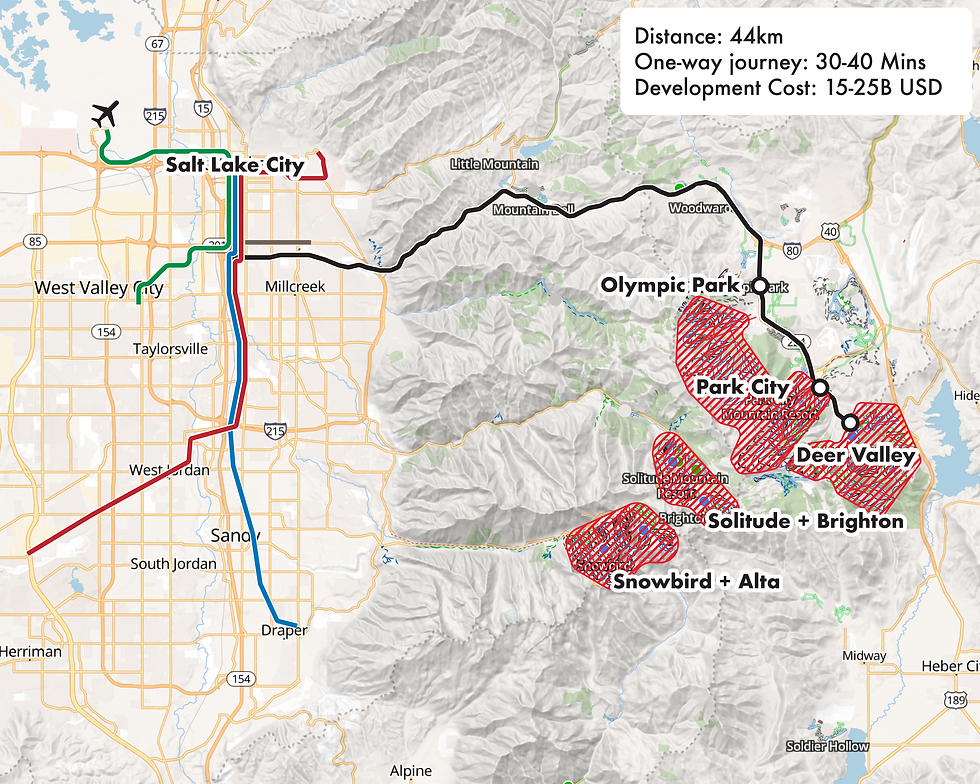
Unfortunately, this would cost A LOT. Light-rail projects in the US typically 75 - 150 million USD per KM, about ten times more than in Europe. Taking this into account, I estimate that a line from downtown Salt Lake City to Park City would cost between 3 and 7 Billion USD, as follows:
New track: 3.2 Billion
Utah's current light rail expansion plans indicate a per KM cost of about 80 million USD. If we apply that to the 44 kilometres of new track required for this route, we're looking at 3.2 billion USD for new track.
Stations: 75 million USD
Light rail stations are smaller than those for mainline railways, and shouldn't cost more than 50 million USD per station. Let's assume we build basic stations for 25 million each. Three stations come out to 75 million USD total.
Trains: 40 million USD
We'd need 6 trains to operate service every thirty minutes. Utah just ordered new light-rail trains in 2024 for about 6.5 million USD per unit, so we'll assume about 40 million USD in train costs.
Contingencies: 3.3 billion USD
Again, I'll account for a 100% contingency factor.
Overall Total: 6.6 Billion USD
6 billion dollars is a lot of money for anything, let alone a train to serve a series of fancy ski resorts and the value proposition gets weakened because of that high cost.
Reports indicate that around 11,000 people visit Park City every day. If we assume average car occupancy and a 100% driving mode-share for those visitors, that means about 9,000 cars travel into Park City every day. Assuming, optimistically, that a rail line could capture 20% of that - a very high mode share for the US - we'd remove 1,800 vehicles from the road per day, saving 500 - 1,000 tonnes of CO2 per year. That's not very much, but like my Canadian proposals, I think this project would provide a lot of benefits to both local Utah residents and visitors: car-free access to nature, reduced congestion and parking demand, and a more efficient way to handle tourism growth.
Caveats
My data is patchy and my assumptions are rough. Cost estimates should be taken with a big grain of salt.
I've skipped over proposals for Colorado and California because I think they'd be so expensive as to be completely unrealistic.
The I-70 resorts in Colorado would require a much longer new line than in Utah, that would cost at least 10 billion USD.
There are existing rail lines leading from the Bay Area to Lake Tahoe but unlike the Canadian Rockies, it would be a much longer ride - about 5 hours - from the city to the first mountain destination.
There are hundreds of transit projects in North American cities that would probably attract higher ridership. My point here isn't to say that these are the best uses of money, just to envision what might be possible.
We Mustn't Be Afraid To Dream A Little Bigger Darling
These projects are, at this stage, unrealistic pipe dreams. The Trump Administration is drastically cutting funding for transit in the US, and Canada struggles to deliver urban transit, forget about remote mountain lines. North America is so behind on public transportation that what money there is should be invested in building transit in cities where more people will use it.
None of that means we shouldn't aspire to these types of projects. Building more public transport into wild environments like the Rockies would enable people to make a lifestyle shift that we should be trying to make easier. Decarbonisation is a massive effort that, right now, tends to ask individuals to sacrifice for the collective good. The more we can present sustainable lifestyle choices that enable people to thrive, not just live, the more people will buy into the overall mission.
Building these railways won't save winter on its own, but making it possible to reach the mountains without a car is the kind of thing we need to do to help future generations have a winter to experience.


