A Vision for High-speed Rail in Switzerland
- Sep 14, 2025
- 5 min read
Updated: Oct 7, 2025
Switzerland is known for, among other things, its trains. They're frequent, punctual, and reliable and because they're good, the Swiss rail system is a roaring success. The Swiss travel more kilometres by rail than any other nationality, and train travel is an integral part of life. Unlike its neighbours though, Switzerland does not have a true high-speed rail network. Swiss trains are middling when it comes to speed, with an average track speed of 95 kilometres-per-hour; faster than some countries like the Netherlands, but slower than France, Germany, and Spain. Switzerland forms a notable gap at the centre of the European high-speed rail network, below.

Switzerland has prioritised reliability over speed
It's no accident that Swiss trains are slower than those in peer countries. In the 1980s, France built Europe's first modern high-speed rail line, prompting many other European countries to follow. At that time, Switzerland's rail policy prioritised frequency and predictability over speed. In the 1970s, Swiss Federal Railways (SBB) began implementing the Takt system, whereby trains are scheduled at repeating clock-facing increments. Switzerland has one of the densest rail networks in the world, and the Takt approach to timetabling allows for highly synchronised and predictable services.
Here's an example of the Takt-system in action between Basel and Zürich. Notice the repeating departing times and trip lengths.

Like its French counterparts, SBB also put forward plans in the '70s and '80s to build high-speed lines across Switzerland. However, these plans were ultimately watered down because they were expensive and somewhat unnecessary, at least for operating a Takt-based timetable.
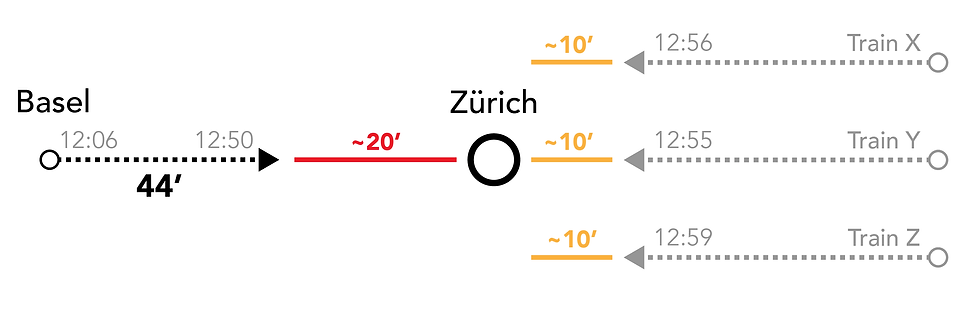
When a rail network is built around precisely-timed and synchronised trips, making those trips faster can mess things up. For example, non-stop trains run the 100 kilometres between Basel and Zürich in 53 or 54 minutes, every thirty minutes (see patterns 1 and 2 above). This ensures that they arrive at either end of their journey at the hour, or at the half hour, and wait about five to ten minutes to sync with other trains.

If the Basel - Zürich trip were, say, 10 minutes faster, these trains would be out of sync with the wider network. A train would arrive and then have to wait about 20 minutes for other trains to connect, before continuing its journey. This is particularly problematic when trains need to travel onward to somewhere else, as any time saved by faster travel on a given segment is lost to mandatory dwell times at major nodes.
To optimise its Takt-based rail system, Switzerland has built some higher-speed lines that help speed up journey segments to get them "in rhythm" with the wider network. A 200 kilometre-per-hour line between Bern and Olten helped bring trip times from Basel/Zürich to Bern under one hour. New 250 kilometre-per-hour trans-alpine base tunnels helped bring trip times from Zürich to Milan to under three-and-a-half hours. Today, the Swiss rail network has a few isolated fast segments, shown below in orange, but nowhere near a true high-speed network.

High-speed rail still makes strategic sense for Switzerland
For the past few decades, SBB's focus has been sensibly on improvements that make the existing rail system work better. It is increasing track capacity at stations, digitising operations, and adding passing tracks to increase frequencies. This focus on the basics ensures that the system will continue to perform well into the future.
But what if Switzerland could add high-speed rail to the mix? What would that look like and what would it do for the country?
While it's not on the cards today, I believe a high-speed rail network would be significantly beneficial to Switzerland. It would better connect the country, make rail more competitive, and would boost national and European economic and social connectivity. Moreover, it could be designed to fit within the Takt-timetable and to complement the existing rail network by freeing up capacity for slower trains.
Here, I've sketched out what I believe to be the most realistic high-speed rail plan for the country, based on existing travel patterns and connections.
Phase 1 would expand the already-underway Léman 2030 project. This project is building new tracks and stations between Genève and Lausanne to separate passenger and freight traffic. It could be modified to increase the speed of these new tracks to bring the journey time between the two cities from about 45 minutes to 30.

Phase 2 centres on a new 250 kilometre-per-hour high-speed line between Lausanne and Bern. This would bring the Bern to Lausanne travel time to around 35 minutes, compared to 1 hour and 10 minutes today, and would play an important role in linking French- and German-speaking Switzerland. A Genève - Bern trip would take just over an hour, compared to 2 hours today.

Phase 3 would see the construction of several new lines in German-speaking Switzerland:
A new 250 kilometre-per-hour tunnel through the Jura between Basel and Olten to reduce the Basel - Olten trip from 30 minutes to 20.
A new 250 kilometre-per-hour high-speed line from Olten to the outskirts of Zürich would reduce the Zürich - Olten trip time from 35 minutes to 25.
A new high-speed line from Winterthur to St. Gallen would bring the Zürich - St. Gallen run time to under 1, allow for Zürich - Munich trips in under 2.5 hours.

Together these projects would dramatically speed up travel across Switzerland. Compare the above travel times to today's travel times along the same routes.

Travel between all of Switzerland's major cities would become faster and easier, and travel across the entire country would be possible in under three hours, compared to almost five today.
Moreover, these faster travel times would still be compatible with the existing rail system and with the takt-timetable, with trains travelling between each major city in about 30 minutes. These 30 minute travel times would ensure that high-speed trains could still stop at major cities at the hour or half hour in order to connect with local and regional trains. Separate high-speed lines would also free-up capacity on the existing network, which is slowly becoming over burdened. This extra capacity could be used to run more regional and local trains to transport Switzerland's growing population, or the presence of parallel high- and slow-speed routes could simply allow for more flexible maintenance of both.
Swiss high-speed rail would also benefit Europe
The Swiss high-speed network I've envisioned would also make some trans-European trips faster. You'll notice below that the addition of an east-west high-speed network in Switzerland does not necessarily align with many north-south trans-European routes, but it would enable many new rail connections that are infeasible today.

Münich to Lyon, for example, could probably be traversed in under 7 hours compared over 9 hours today. Trips from the Frankfurt Airport to Lausanne and Genève would also be more feasible, at about four-and-a-half and five hours respectively. Perhaps more interestingly, travel from Switzerland's airports into southern France and western Austria would also become much easier, as would trips from Switzerland to the south of France and even Spain. And if Switzerland's European neighbours were ever to build high-speed rail connections directly into Switzerland, many more rail journeys could become even more competitive.
Towards a Faster Future
The scheme I've envisioned here would be expensive and would take decades to build out. It also does not align with current expansion plans and the present focus on increasing frequency and reliability. None of this however, changes the fact that a high-speed rail network would be a good thing for Switzerland. The country is growing fast and can afford big-ticket infrastructure investments, especially the kind that benefit a wide swathe of the population. This post is really just a visioning exercise and any serious proposal would require a lot more research into costs, tradeoffs, and feasibility. I hope though, that someday we might achieve some version of this vision and in doing so, propel the country towards a more sustainable, livable, and prosperous future.


